Five Decisions in Designing an Educational Simulation
Designing educational simulations is mostly an exercise in subtraction. The technology will happily show the learner everything: the value, the graph, the answer. The instructional work is deciding what to withhold, and defending that decision when it makes the product look less impressive in a demo.
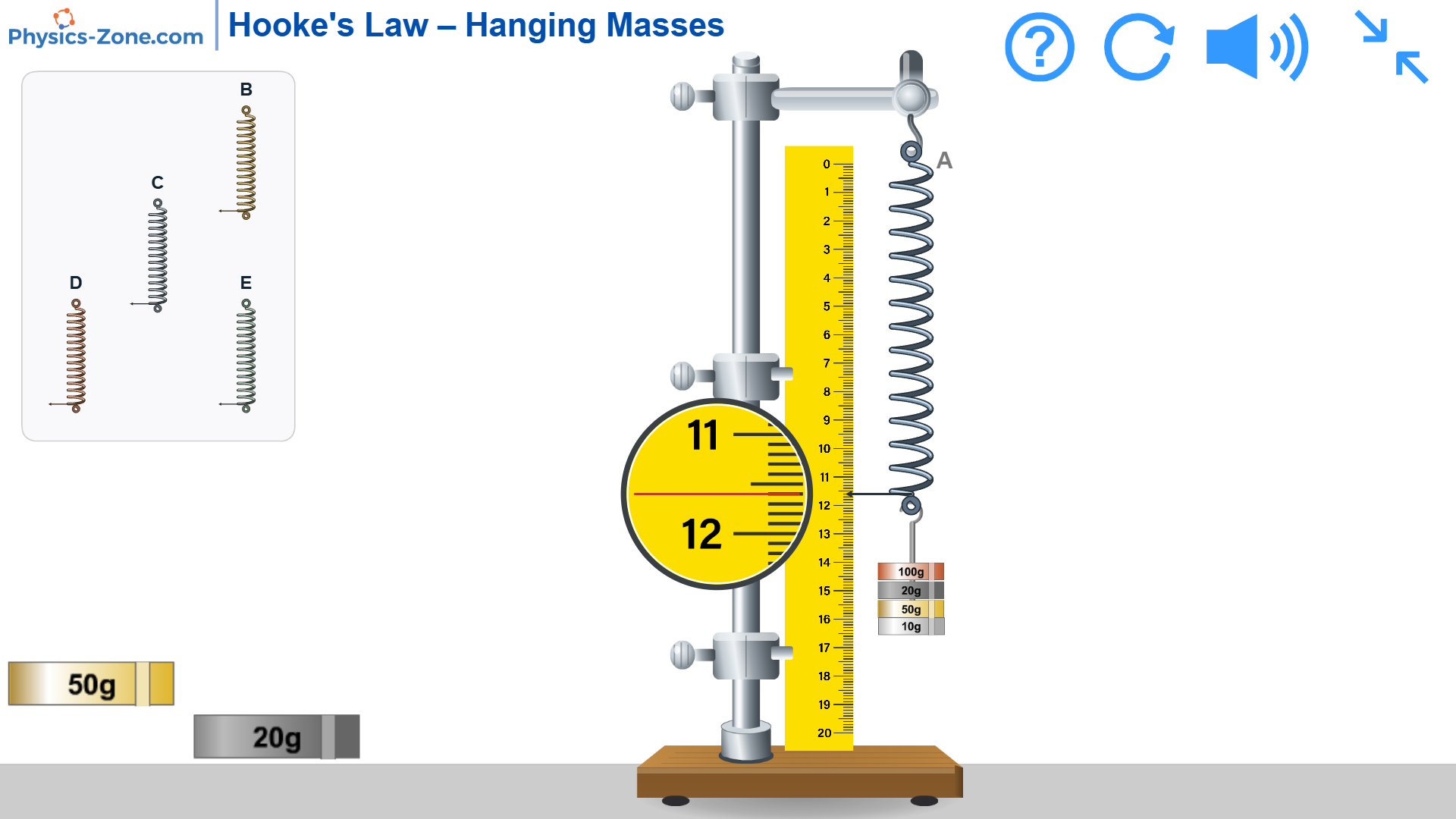
I have just finished a Hooke’s law lab for Physics Zone – five springs, a set of slotted masses, a ruler – and the five decisions below shaped it more than any technical choice did.
1. Withhold the thing being taught
The spring constant appears nowhere on screen. Not in a readout, not in a tooltip, not on the springs themselves. Learners hang masses, read the spring’s length, subtract the no-load reading, convert mass to force, and find the constant ratio for themselves.
This is uncomfortable to build. Every instinct of interface design says show the user the useful number. But the useful number is the learning objective, and an objective displayed is an objective skipped. The measurement steps are not friction to be removed – they are the lesson.
2. Replace the input control with an apparatus
The conventional solution is a slider labeled “force”. Drag it and the spring stretches. It is easy to build, easy to use, and it teaches almost nothing, because force has become a number you dial rather than a quantity you assemble.
So there is no slider. There is a 10 g hanger that has to go on first, because the other masses stack on it, and there are discrete pieces added one at a time. The learner does what they would do at the bench, in the order they would do it. Procedural fidelity matters here more than visual fidelity: the apparatus does not need to be photographic, it needs to impose the same sequence.
3. Let the mistake be real
Load a spring past its elastic limit and it yields. It stretches further than the law predicts, and it keeps part of that stretch for good. Take the masses off and it settles at a new, longer length instead of returning to where it started. The learner measures the difference: the damage is not announced, it is read off the ruler.
Most educational software is built to prevent exactly this. Errors are caught, softened, undone. But elasticity is a range rather than a property, and a learner who has ruined a spring understands where that range ends in a way that a warning message cannot deliver. The consequence has to survive for the concept to land – with the important caveat that it must be recoverable at the task level, not the session level. Losing one spring teaches. Losing the whole experiment punishes.
There is a second reason to let the damage persist rather than freeze the apparatus. Because the spring can still be loaded and unloaded afterwards, the learner can use the method a technician would: load, read, unload, check that it recovers, repeat – until one load leaves it permanently longer. The elastic limit is not stated anywhere; it is bracketed between the heaviest load the spring survived and the one that ruined it.
4. Scaffold at the moment of need, not in advance
Two short callouts appear only when the learner does something the apparatus does not allow: hanging a mass with no spring mounted, or skipping the hanger that the other masses stack on. Each one names the rule at the exact moment it becomes relevant, then disappears.
The guided tutorial follows the same principle. It is optional, it can be opened halfway through an experiment, and it restores the learner’s setup exactly when it closes – so consulting help never costs them their work. Front-loading instructions asks a learner to remember rules for a task they have not started; just-in-time guidance asks them to apply a rule they have just needed.
5. Design for the teacher’s workflow too
This is the decision most easily forgotten. The learner is the user, but the teacher is the one who adopts, deploys, and grades.
The five springs could have been randomized – a different stiffness behind each letter on every load, so answers could never be shared. I built it that way first, then reversed it. Fixed springs mean spring C behaves identically in every session and on every computer, and a class can be graded against a single key. The cost is real: results can circulate between groups. It was accepted deliberately, because a tool that cannot be graded does not get used twice.
What generalizes
None of this is specific to springs. The pattern holds for most procedural science content: identify the step where the thinking happens, refuse to automate that step, make the consequence of error visible, deliver guidance at the point of failure, and design the reporting path for whoever has to assess it. The hard part is not building the interaction. It is holding the line on what the simulation will not do for the learner.