Rebuilding Projectile Game
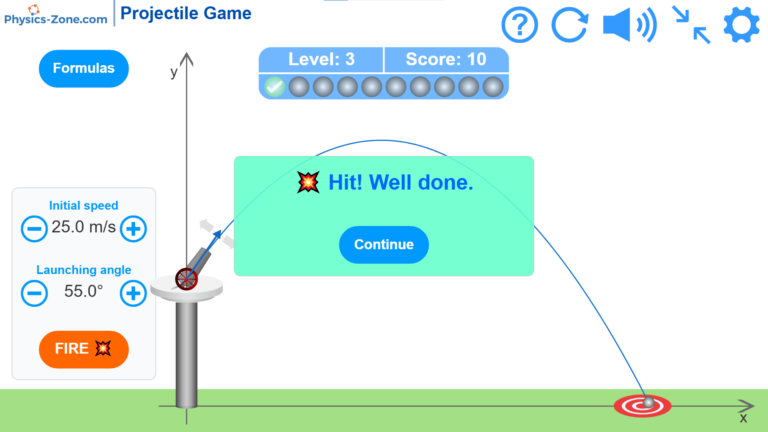
Four levels ordered by which equation they need, and a tutorial that drives the live simulation instead of pointing at it with callouts.

Four levels ordered by which equation they need, and a tutorial that drives the live simulation instead of pointing at it with callouts.

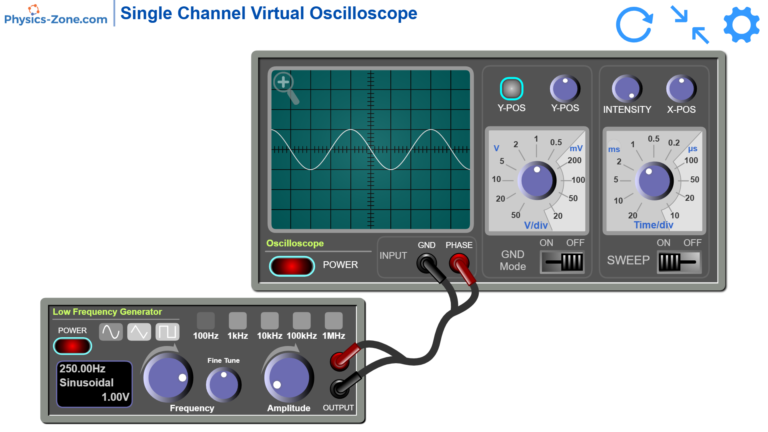
A new interactive single-channel virtual oscilloscope simulation, developed in response to educator feedback requesting a simpler tool for intermediate physics classes. Part of a growing library of high-quality simulations on Physics-Zone.com.

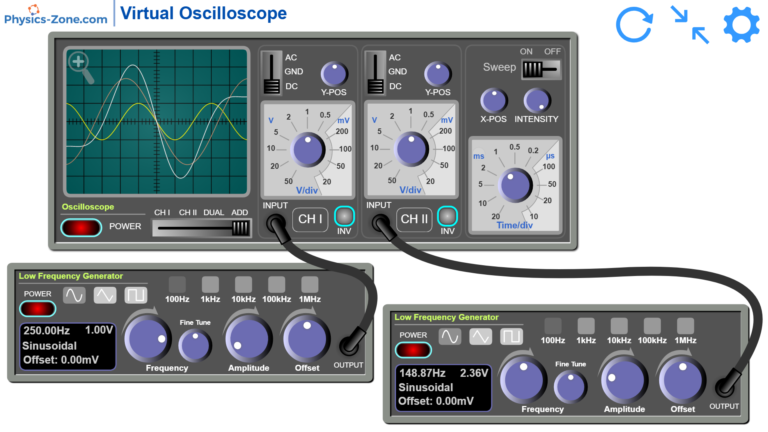
A new release of my Virtual Oscilloscope simulation, built with CreateJS, introducing Signal Addition (ADD) mode for exploring superposition, along with frequency fine-tuning, a screen magnifier, and a cleaner interface.

Educational technology is more about strategically leveraging technology to enhance, transform, and even redefine teaching and learning than just merging education with technology. You have to be a strong educator equipped with learning theories, educational methodologies, and statistical analysis in the first place to be a successful educational technologist.

This story always reminds me how much work we still have to do to bridge the gap in technological literacy among educators!

In creating interactive educational tools, simplicity is power. A minimalist design doesn’t just look clean; it helps learners focus on what truly matters. Instead of overwhelming the user with unnecessary details, focus on providing a clear, interactive interface that mirrors the real-world experience.

That moment stuck with me. It showed me how powerful simulations can be in breaking down complex ideas. It’s the reason I decided to learn how to develop science simulations to make learning easier for others.
Sometimes, all it takes is one moment to change your path!

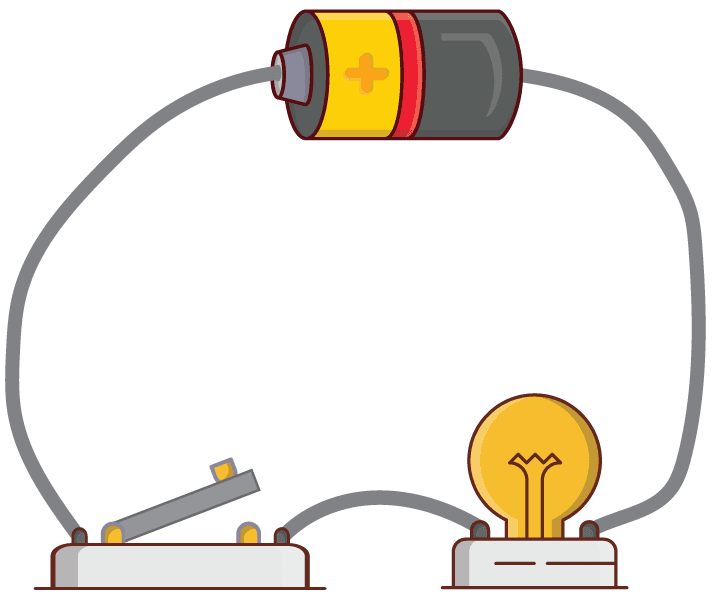
I conducted countless experiments in class throughout the course of my many years of teaching physics to motivate the students. However, I had never anticipated to find that nothing delighted the students as much as the simplest activity where I or the students made a light bulb light up by connecting a switch, wires and a battery.

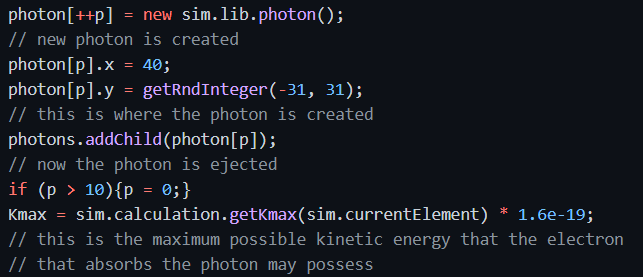
These lines portray a tale of creation and vanishing. It describes the creation of a photon, its subsequent disappearance when an electron absorbs it on the cathode plate’s surface, the subsequent departure of the electron from the cathode, and lastly the eventual disappearance of the electron when it reaches the other plate and captured.

The paper: Using a web-based and stand-alone oscilloscope for physics experiment during Covid-19 pandemic, Mahizah Ismail et al (2023), Phys. Educ. 58 015006, is based on the Virtual Oscilloscope simulation. This paper was authored by Mahizah Ismail, Farid Minawi, Wan Zul Adli Wan Mokhtar, Noraihan L Abdul Rashid and Ahmad K Ariffin.
The article DOI: https://iopscience.iop.org/article/10.1088/1361-6552/ac95eb