Similar Posts
Interference of Waves Simulation
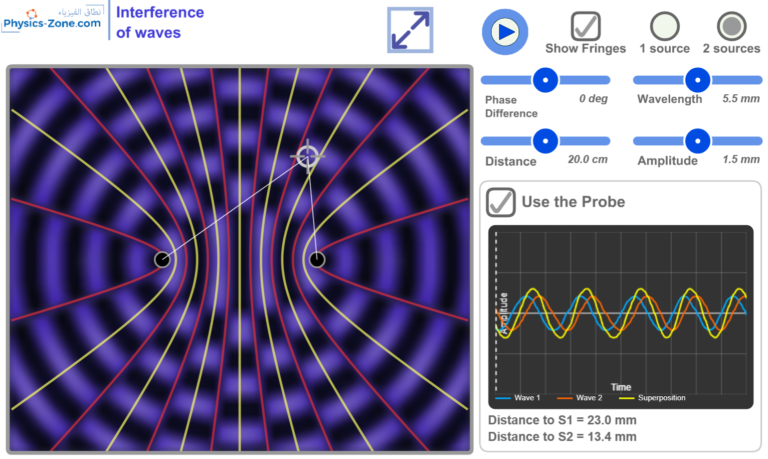
This interactive wave interference simulation demonstrates the fundamental principles of wave superposition using two sources. Users can adjust key parameters including wavelength, amplitude, phase difference, and source separation to observe how waves interact and produce complex interference patterns. The simulation features a real-time probe tool that displays individual wave amplitudes and their resultant superposition, showing constructive and destructive interference at different points in the field. The visual representation includes radiating wave fronts from both sources, with characteristic alternating bands of high and low amplitude clearly visible throughout the interference pattern.
Projectile Game
In this game, you must employ the projectile equations to win.
The game consists of three levels, each of which must be completed by scoring at least 8 out of a possible 10 tries. In the first level, you must hit a ground target that shifts position after each attempt. In the second level, you will need to alter the ball’s trajectory to pass over a wall. In the third level, the target flies and changes position both horizontally and vertically in each trial.
Don’t do it, train your own AI to do it!
If this future becomes reality, there will be a massive wave of job displacement as AI takes over across various industries and job markets. But a wide horizon of opportunities will rise. Instead of a position of making decisions in a company, there will be a position of training the AI to make that decision and to maintain its logic.
As a bizarre example, companies might not need IT (Information Technology) officers anymore! Instead, they might employ AIT (Artificial Intelligence Technology) officers, whose main responsibility is training and maintaining the company’s AI model to solve the company’s technical issues!
Phase Difference Between Sound Waves Simulation
With this rich simulation, you can visualize and measure the phase difference between two sound waves using two microphones connected to an oscilloscope. Moreover, you can determine the speed of sound in air by measuring the distance between the two microphones when their waveforms are in phase, taking into account the frequency of the sound wave that is controlled by the sine wave generator.
When my Virtual Oscilloscope was mistaken for just a picture!
This story always reminds me how much work we still have to do in Lebanon to bridge the gap in technological literacy among educators!
Charging by Induction Simulation
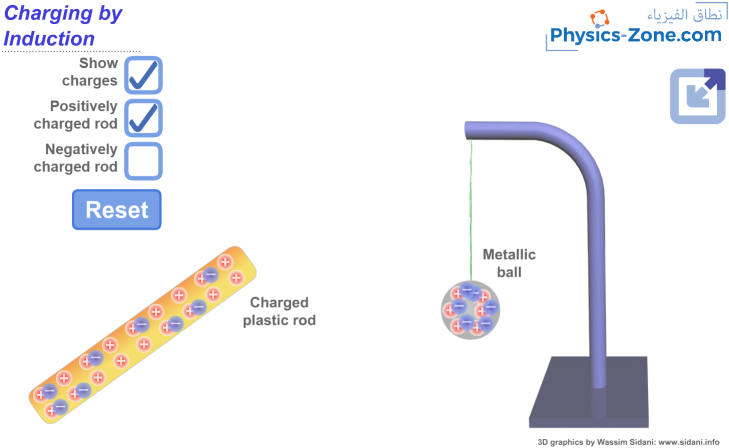
Using this simulation, you can experience the phenomenon of charging a metallic ball by induction in the first stage and charging the ball by contact in the second stage after the charged rod touches the ball. The displayed charges are for an illustrational purpose, and they are not seen in reality. You can disable the display of charges on the rod and on the ball.
In this simulation, you can try two situations, one in which the rod is positively charged and another in which the rod is negatively charged, and you will see that the two situations result in the same observation.