| |

Charging by Induction Simulation

Using this simulation, you can experience the phenomenon of charging a metallic ball by induction in the first stage and charging the ball by contact in the second stage after the charged rod touches the ball. The displayed charges are for an illustrational purpose, and they are not seen in reality. You can disable the display of charges on the rod and on the ball.
In this simulation, you can try two situations, one in which the rod is positively charged and another in which the rod is negatively charged, and you will see that the two situations result in the same observation.

Charging by Induction Simulation

Similar Posts

  • |

    Newton’s second law

    Newton’s second law states that net force and acceleration are directly proportional, with mass as the constant of proportionality (F=ma). This experiment uses an anvil supported by air pressure to demonstrate that even when weight is counteracted, the anvil’s huge mass still requires enormous force to accelerate it from rest. A powerful illustration of the relationship between force, mass, and acceleration.

  • |

    القصور الذاتي

    القصور الذاتي هو خاصية المادة التي تقاوم التغييرات في السرعة المتجهة. عندما تكبح السيارة، يميل جسمك للأمام؛ وعندما تتسارع، تميل للخلف – كلاهما يوضح القصور الذاتي عملياً. كلما زادت كتلة جسمك، كان التأثير أكثر وضوحاً. يشمل القصور الذاتي مقاومة التغييرات في كل من مقدار السرعة واتجاه الحركة، مما يجعله مفهوماً أساسياً لفهم سلوك الأجسام.

  • | |

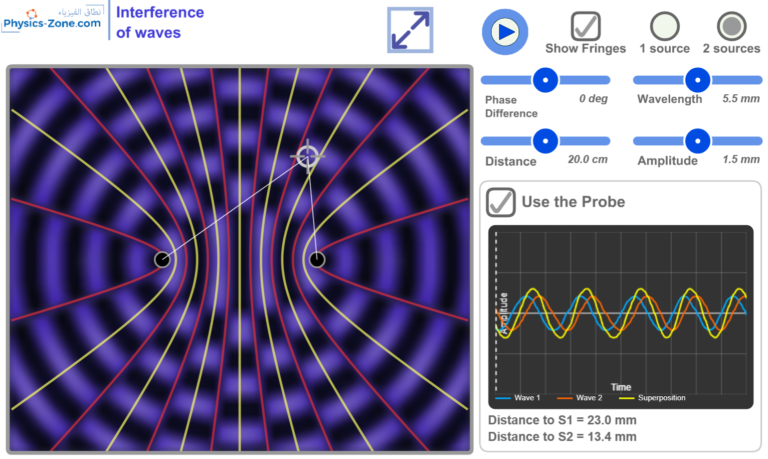
    Interference of Waves Simulation

    This interactive wave interference simulation demonstrates the fundamental principles of wave superposition using two sources. Users can adjust key parameters including wavelength, amplitude, phase difference, and source separation to observe how waves interact and produce complex interference patterns. The simulation features a real-time probe tool that displays individual wave amplitudes and their resultant superposition, showing constructive and destructive interference at different points in the field. The visual representation includes radiating wave fronts from both sources, with characteristic alternating bands of high and low amplitude clearly visible throughout the interference pattern.

  • |

    Inertia

    Inertia is the property of matter that resists changes in velocity. When a car brakes, your body leans forward; when it accelerates, you lean backward – both demonstrate inertia in action. The greater your body’s mass, the more pronounced this effect. Inertia encompasses resistance to changes in both speed and direction of motion, making it a fundamental concept in understanding how objects behave.

  • |

    Conservation of linear momentum

    This demonstration explains conservation of linear momentum through cannon recoil. When a cannon fires a bullet, it recoils backward with much lower velocity due to its greater mass, illustrating the inverse relationship between mass and velocity. The post provides complete mathematical derivations showing that total momentum remains constant in an isolated system where net external force is zero.

  • |

    مبدأ ارخميدس

    توضح هذه التجربة مبدأ أرخميدس والطفو. عند وضع جسم في سائل، يزيح كمية من السائل تساوي كتلتها كتلة الجسم نفسه. كما أن حجم السائل المُزاح يساوي حجم الجزء المغمور من الجسم. عرض أساسي لمبادئ ميكانيكا الموائع والإزاحة.

Leave a Reply

Your email address will not be published. Required fields are marked *