|

Inertia

لقراءة النسخة العربية أنقر هنا.

When you feel your body is leaning forward when the car is braking, or when your body leans backward when the car takes off, you are experiencing a property of your body that is called “inertia”. The greater the mass of your body, the more you feel this effect.
Inertia is defined as the resistance of the body to any change in its velocity. This includes changes to the body’s speed or direction of motion.

Similar Posts

  • |

    Conservation of linear momentum

    This demonstration explains conservation of linear momentum through cannon recoil. When a cannon fires a bullet, it recoils backward with much lower velocity due to its greater mass, illustrating the inverse relationship between mass and velocity. The post provides complete mathematical derivations showing that total momentum remains constant in an isolated system where net external force is zero.

  • A new publication based on the Virtual Oscilloscope simulation

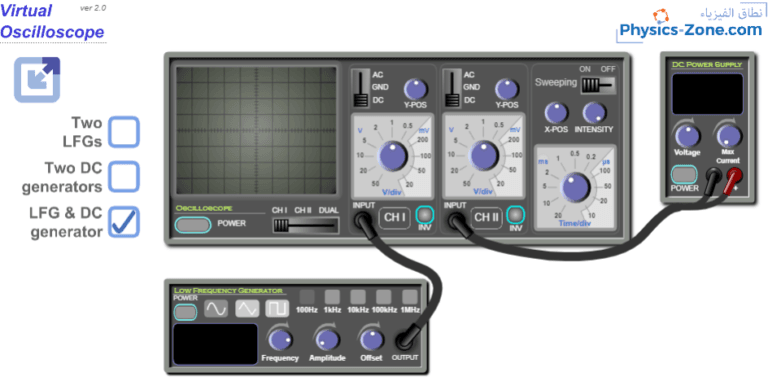
    The paper: Using a web-based and stand-alone oscilloscope for physics experiment during Covid-19 pandemic, Mahizah Ismail et al (2023),  Phys. Educ. 58 015006, is based on the Virtual Oscilloscope simulation. This paper was authored by Mahizah Ismail, Farid Minawi, Wan Zul Adli Wan Mokhtar, Noraihan L Abdul Rashid and Ahmad K Ariffin.
    The article DOI: https://iopscience.iop.org/article/10.1088/1361-6552/ac95eb

  • | |

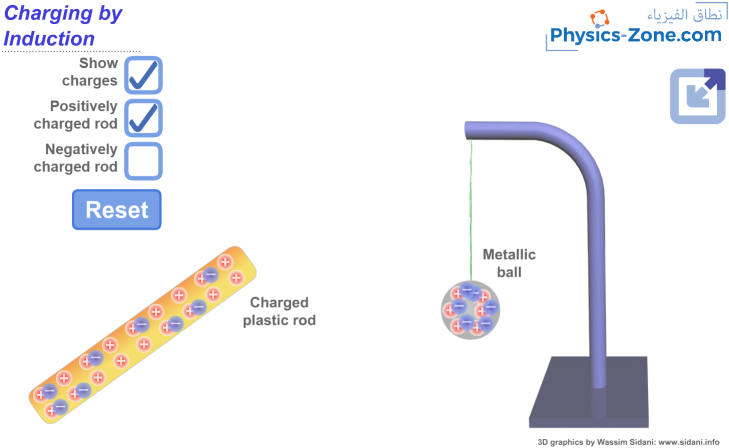
    Charging by Induction Simulation

    Using this simulation, you can experience the phenomenon of charging a metallic ball by induction in the first stage and charging the ball by contact in the second stage after the charged rod touches the ball. The displayed charges are for an illustrational purpose, and they are not seen in reality. You can disable the display of charges on the rod and on the ball.
    In this simulation, you can try two situations, one in which the rod is positively charged and another in which the rod is negatively charged, and you will see that the two situations result in the same observation.

  • | |

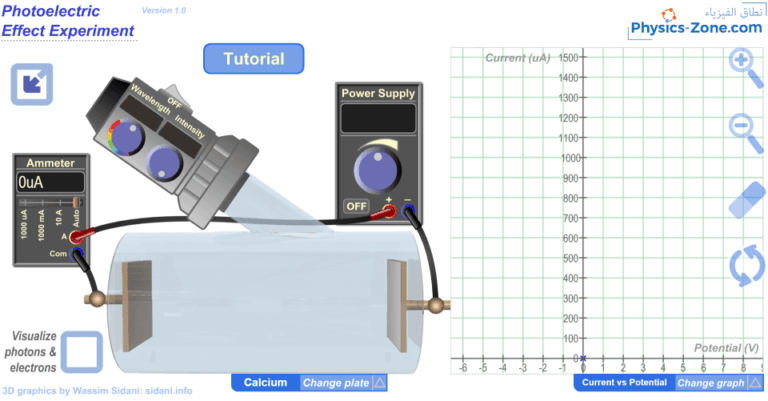
    Photoelectric Effect Experiment Simulation

    With this comprehensive and realistic-like photoelectric effect experiment simulation, you will be able to illustrate the following:
    The variations of the photocurrent versus potential.
    The variations of the photocurrent versus light intensity.
    The variation of the kinetic energy of the ejected electrons versus the incident light frequency.
    It comes with a graph where you can trace each type of variation as you vary the parameters of the experiment.
    Plus, you can experiment and discover more with this simulation.

  • |

    قانون نيوتن الثالث

    يوضح قانون نيوتن الثالث أن لكل فعل رد فعل مساوٍ له في المقدار ومعاكس له في الاتجاه. يستخدم هذا الفيديو مشهداً من فيلم جاكي تشان لتوضيح المبدأ: عندما يدفع جاكي شريكه (قوة الفعل)، يختبر دفعة مساوية إلى الخلف (قوة رد الفعل)، مما يسمح لكليهما بالهروب من الخطر. مثال إبداعي من الحياة الواقعية على أزواج قوى الفعل ورد الفعل.

Leave a Reply

Your email address will not be published. Required fields are marked *