Newton’s Tube Simulation

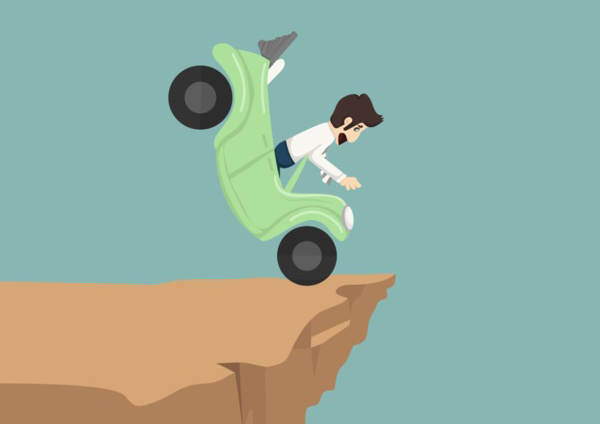
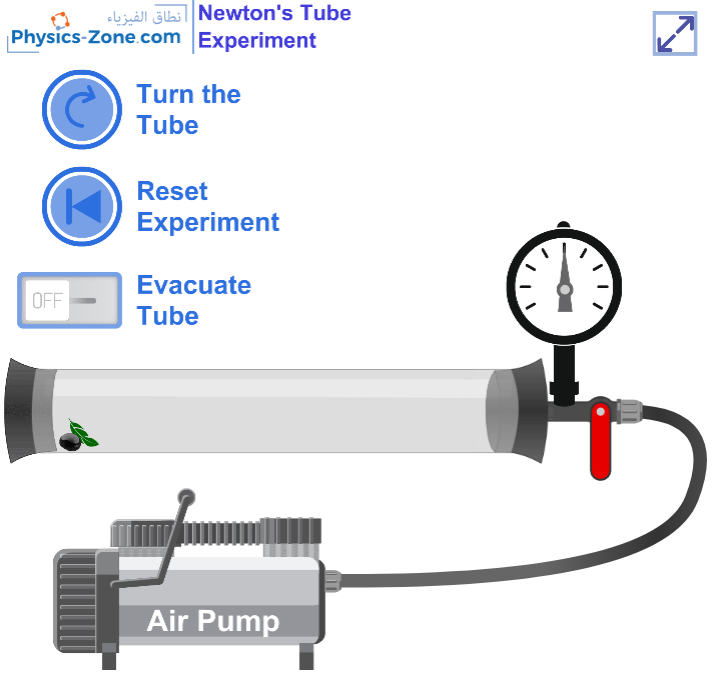
This simulation models Newton’s tube experiment, showing how air resistance affects falling objects. By removing air from the tube and flipping it, users can observe how a feather and a pebble fall differently in air but identically in a vacuum—demonstrating that gravity accelerates all objects equally when air resistance is removed.
Newton's Tube Simulation


Similar Posts

  • العدسة الثقالية

    من النتائج العجيبة لنظرية النسبية العامة أن الأجسام وبسبب المجال الثقالي (الجذبي) الناتج عن كتلتها (كمية المادة) تُقوّس نسيج الزمان-المكان (أو اختصارا الزمكان). وهذا التقوس لا يكون محسوسا بالقرب من الأجسام الصغيرة كأجسامنا، ولكنها تصبح ذات مقدار ملموس بالقرب من الأجسام الهائلة كالكواكب والنجوم.

    وإذا خضنا أكثر في نتائج التقوس الزمكاني الذي تنبأت به نظرية النسبية العامة، وأخذنا بعين الاعتبار نجمين نراهما على أطراف كوكب هائل الكتلة، فإننا نرى كل واحد منهما منزاحا عن موقعه الحقيقي بحيث أن المسافة الظاهرية بينهما أكبر من المسافة الحقيقية. وبالتالي فإن المسافة بينهما قد تضخمت بمقدار ضئيل ربما نستطيع أن نتحقق منه بأعيننا المجردة أو بواسطة التليسكوب.

  • |

    Long Division Simulation – Remainder

    If you or your student or child are having difficulties in learning long division, then you will find this simulation comprehensive and instructional, that guides the learner through the process step by step. This application is for long division with remainder. Another application on long division with float quotient is also available in the simulations section.

  • Simplicity is power

    In creating interactive educational tools, simplicity is power. A minimalist design doesn’t just look clean; it helps learners focus on what truly matters. Instead of overwhelming the user with unnecessary details, focus on providing a clear, interactive interface that mirrors the real-world experience.

  • Newton’s first law

    In this experiment, the air cushion under the scooter assures that there is almost no friction, so the scooter is acted upon by the gravitational force (its weight) and the reaction of the track. Then we can say that the net force on the scooter is null.
    Now when the scooter is at rest, it remains at rest. But when it is given a push and then is left to move on its own, it will keep moving at constant speed unless it hits the end of the track (a force stops it).

Leave a Reply

Your email address will not be published. Required fields are marked *

one × two =