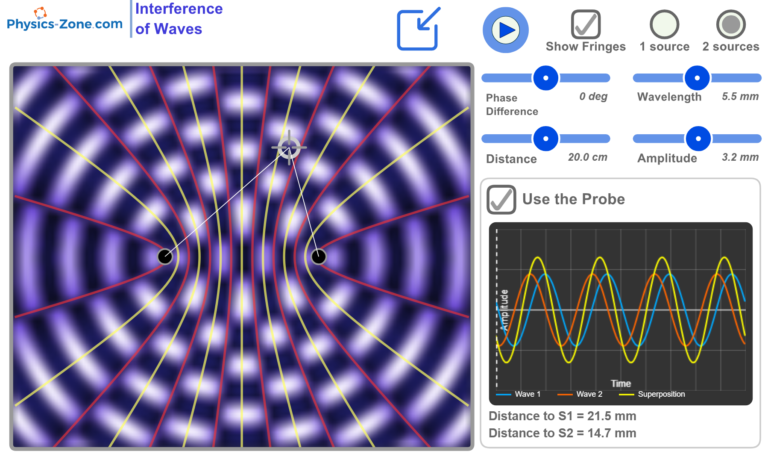
Interference of Waves Simulation

This interactive wave interference simulation demonstrates the fundamental principles of wave superposition using two sources. Users can adjust key parameters including wavelength, amplitude, phase difference, and source separation to observe how waves interact and produce complex interference patterns. The simulation features a real-time probe tool that displays individual wave amplitudes and their resultant superposition, showing constructive and destructive interference at different points in the field. The visual representation includes radiating wave fronts from both sources, with characteristic alternating bands of high and low amplitude clearly visible throughout the interference pattern.
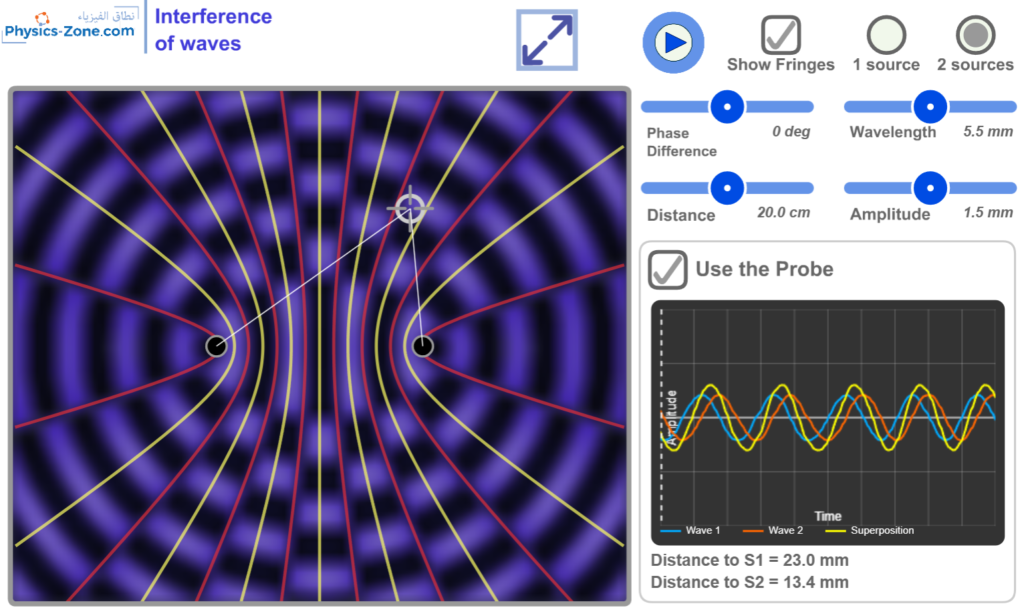
Interference of Waves Simulaton

Similar Posts

  • |

    تجربة السقوط الحر

    توضح هذه التجربة أنه عند انعدام مقاومة الهواء، يصل جسمان يسقطان بحرية من نفس الارتفاع إلى الأرض في نفس اللحظة. يكتسب كلا الجسمين نفس السرعة أثناء السقوط، مما يثبت أنهما يختبران نفس التسارع – تسارع السقوط الحر. تشرح التجربة سبب رؤيتنا للأجسام الثقيلة تسقط أسرع من الأجسام الخفيفة بسبب تأثيرات مقاومة الهواء.

  • Don’t do it, train your own AI to do it!

    If this future becomes reality, there will be a massive wave of job displacement as AI takes over across various industries and job markets. But a wide horizon of opportunities will rise. Instead of a position of making decisions in a company, there will be a position of training the AI to make that decision and to maintain its logic.
    As a bizarre example, companies might not need IT (Information Technology) officers anymore! Instead, they might employ AIT (Artificial Intelligence Technology) officers, whose main responsibility is training and maintaining the company’s AI model to solve the company’s technical issues!

  • Simplicity is power

    In creating interactive educational tools, simplicity is power. A minimalist design doesn’t just look clean; it helps learners focus on what truly matters. Instead of overwhelming the user with unnecessary details, focus on providing a clear, interactive interface that mirrors the real-world experience.

  • |

    Conservation of linear momentum

    This demonstration explains conservation of linear momentum through cannon recoil. When a cannon fires a bullet, it recoils backward with much lower velocity due to its greater mass, illustrating the inverse relationship between mass and velocity. The post provides complete mathematical derivations showing that total momentum remains constant in an isolated system where net external force is zero.

  • |

    Newton’s second law

    Newton’s second law states that net force and acceleration are directly proportional, with mass as the constant of proportionality (F=ma). This experiment uses an anvil supported by air pressure to demonstrate that even when weight is counteracted, the anvil’s huge mass still requires enormous force to accelerate it from rest. A powerful illustration of the relationship between force, mass, and acceleration.

Leave a Reply

Your email address will not be published. Required fields are marked *

five × three =